Printed fromJewishPittsford.com
ב"ה

Rabbi's Blog

Thought of the Week

Dear Friends,


This past Wednesday, I had the last-minute privilege to spend some time with everyone-in-Rochesters-friend Rabbi Avi Kilimnick right before he left back to the holy land. How time flies! 


Among our 90 minutes of schmoozing was the idea of how time is a constant force. Time is inevitable and how all of us have to keep re-thinking and reapplying all the Judaism and Torah values to go deeper and truer. If not for us, then we must go deeper for the next generation of youth (he teaches at a Yeshiva in Israel and I deal with local teens), because they are actually the ones who will not be satisfied with anything less than the deepest truths. 

About passing leadership to the next generation - here is a fresh take on the past week by my colleague Mendy Kaminker:


Did you hear the news this past week? G-d A-lmighty himself came to a world leader and said: "The era of your leadership is over! It's time for you to go and pass the torch to the next generation."

Do you think I am about to discuss politics? Of course not! I am just talking about this week's Parsha!!

The "Alter Rebbe," Rabbi Schneur Zalman, the founder of Chabad Chassidism, suggested that we "live" with the weekly Parsha. Every week, we should study and pay attention to the Torah portion of that week, as if it was breaking news. And by pure divine providence, this week we learn in the Parsha about the change of leadership —from Moshe (Moses) to Yehoshua (Joshua).

So yes, reading the breaking news about the leadership changes in the world's largest democracy, made me think about this week's Parsha. And no, I am not about to discuss politics whatsoever, only to focus on the Parsha and the lessons we can apply in our lives.

When I think of Moshe, "servant leadership" comes to mind. As the Harvard website explains, "Servant leadership theory, which dates to the 1970s, argues that leaders have a duty to focus primarily on meeting their subordinates' needs rather than on their own or those of the organization."

Thousands of years before the servant leadership theory, Moshe was a perfect example of a servant leader. He always prioritized his people over himself. Even a quick look at our Parsha, describing what Moshe was occupied with in his last days on earth, tells you that story.

"Go up to Mount Abarim," G-d is instructing Moshe, as this is going to be his last destination and his resting place as well. Moshe is acutely aware that these are his last days, but before he goes, he has one final request from G-d:

Take good care of my people.

"Let the L-rd, the G-d of spirits of all flesh, appoint a man over the congregation! (May it be a devoted person) who will go forth before them and come before them, who will lead them out and bring them in, so that the congregation of the L-rd will not be like sheep without a shepherd!"

In response, G-d is commanding Moshe to appoint Yehoshua as the next leader of the Jewish people.

The Torah is filled with many other similar examples. Time and again, Moshe cares for his flock, and when needed he is willing to risk his legacy to save the Jewish people.

But Moshe had another element that the servant leadership theory neglects to focus on: he was not only a servant of his people, but he was called—by G-d himself!—a "servant of G-d." We can easily see how the two are connected: being a totally-devoted servant of G-d had a direct impact on him being a totally-devoted servant of the people.

Because he loved G-d, and he loved the people that G-d created.

Now, the question is: can we be like Moshe? Can we strive to reach the level of his devotion to G-d and his people? Can we be servant leaders?

To answer that, let me quote another profound saying by the first Rebbe of Chabad:

"Everyone has some of Moshe inside them."


Wishing you a Shabbat Shalom,

Rabbi Yitzi and Rishi Hein
Thought of the Week


It has been a busy but extra-fulfilling week for me. Monday was spent driving to drop Mendel off at Newark Airport for his Israel Summer Program. Tuesday was my actual birthday and a last push for the  1st Annual Raffle (See winners below). Wednesday was teaching JLI and Thursday was a beautiful Whiskey and Torah event for my b-day and raffle drawing (see winners below).

One story that I read this week (from the JLI course) moved me so deeply that I shared it last night at my b-day event and I feel I have to share it with you here. Oh, and it ties well into this week's Torah portion Balak. 

It is about Natan Sharansky and is from his book with Shira Wolosky Weiss, Defending Identity: Its Indispensable Role in Protecting Democracy, pp.24-25. For those unfamiliar, Natan Sharansky is famous for being a refusnik who spent 9 years in Soviet prison as he defied the USSR and tried to emigrate to Israel. Here is the excerpt in Natan Sharansky's words:


"A few days before my arrest, an American tourist gave me a small book of Psalms from my wife, along with a letter she had written. In it Avital explained that she had carried the Psalms with her all year, during her travels around the world to fight for my freedom and for the freedom of Soviet Jewry. Now, she wrote, I feel that you should have it so I am sending it to you. Back then, my Hebrew was in no way adequate to read that book. After I was arrested, the book, along with all my other belongings, was confiscated. Then I began to think about the Psalms and about the note from Avital. The book soon took on an almost mythical meaning for me. I started to fight to have it returned, a battle that continued for three years. I finally received the book along with the news that my father had passed away. I tried to read it, but I still understood little. I had to work my way through it slowly, page by page, comparing different lines, trying to recognize patterns and connect words to each other. The first lines I understood were those of Psalm 23: “Although I walk through the valley of death, I fear no evil, for You are with me.”

I noticed that in the Psalms, the word fear kept appearing. On the one hand, fear was something to be overcome, such as not fearing evil. But as Yirat Hashem, or the fear/awe of G-d, it had a positive connotation. It took me time to understand what this fear of G-d meant. My understanding was at first very vague and uncertain. But at some moment it occurred to me, seeing it many times, that this fear was connected not simply to G-d the Creator but to the image of G-d in which man was created. Mankind was created to be worthy of that image and to be true to it. This required me to go forward in an honest and direct way, without compromising principles. This fear, the fear of not being worthy of the Divine image, not the fear of death, was what I was most afraid of in my interrogations with the KGB. I was afraid to lose the world of inner freedom I had found, to fail to stay true to my inner self, to no longer conduct myself in a way that was worthy of the divine image."


Wow. To me this is gold. This is what it means to be a real religious person with faith and reverence for G-d. It is not fear of something out there but rather respecting something deep inside our core. This is what gave Sharansky the power to resist the KGB dictatorship.

This is what Jews have brought to the world. Many dictators don't like this but it is the truth and by standing strong we teach all of humanity what it means to be a human being, that we are all created with deep powers that stem from our soul being created in the image of G-d.

This week's parsha is Parshat Balak. The Torah tells us that Balak was a non-Jewish king who hated the Jews. This Jew-hater hired a prophet by the name of Balaam to curse the Jewish people. Balaam was a person with great spiritual powers who was able to curse and bless, and Balak expected him to inflict much harm on the Jewish people using his curses. Balak and Balaam both couldn't stand the Jewish people and that G-d chose them for a historic mission to be a light unto the nations.

In the end - you guessed it - the plan backfired. Not only didn't Balaam curse the Jews, he ended up blessing them.

Let this be a message to Jews everywhere and the world at large: We must and will continue shining the light that Sharansky was talking about. 

No one will be able to stop this mission and destiny. People can try to imitate Balak and Balaam , but in the end we saw what happens - not curses but blessings will come to the Jewish people, and we will extend those blessings to all of humanity.


Good Shabbos/Shabbat Shalom,

Rabbi Yitzi and Rishi Hein


Thought of the Week


As you may know, this past week I travelled to the Rebbe's Ohel in honor of his 30th yahrzeit. I was joined by Jews of all stripes (as well as non-Jewish people, including NYC Mayor Eric Adams) coming to connect to the Rebbe's legacy.

Or perhaps "legacy" is the wrong word. The Rebbe wasn't just a unique leader who did incredible things for the world. More than anything, the Rebbe's greatest feat was "empowerment." In the words of the late Rabbi Jonathan Sacks OBM, "the Rebbe didn't create followers; he created leaders. That was the Rebbe’s greatness. Not only did he lead, he was a source of leadership in others." 

30 years after his passing, his still present voice is asking, begging, all of us to dig deep and lead. 

The need for all of us to be all types of leaders is beautifully reflected in this week's Torah portion of Chukat:

The Jews who traveled through a desert for forty years received three gifts that would sustain them throughout their journey. Each miracle was in the merit of one of their three great leaders:

In Miriam's merit a rock-turned-well traveled with them, providing a never-ending source of water in the desert. In Aaron's merit the Clouds of Glory offered the Jews protection from the many dangers they faced, reminding them constantly of G-d’s care and love for them. And Moses was the leader in whose honor the daily manna fell from heaven.

Obviously, there is a direct link between each one of these three leaders, and the amazing miracles with which they are associated.

Miriam excelled in kindness. From her youth she devoted herself to her people's welfare. Even as a small girl, she assisted her mother as a midwife and brought food to the poor. When her helpless brother was in a basket floating down the Nile, it was Miriam watching from the reeds that was able to ensure her brother was saved and fed.

Because of her attribute of kindness, G-d provided the Jews with water. Always flowing downwards, water is the source of all life and growth. This is the gift Miriam gives the Jews. Not only a vital necessity, but a symbol of kindness, of growth, and of always giving graciously.  

Aaron, the High Priest personified both closeness to G-d and "Shalom." His devotion to the service in the Temple revealed G-d's presence to the Jews in the desert.  Hence, the protective Clouds of Glory, a  source of pride and honor for a nation so carefully loved by G-d.  Through his peace-making abilities, Aharon was also known for bringing tranquility back to marriages and friendships. 

This was Aaron’s gift; revealing G-d’s closeness to us, and our closeness to each other.  

Moshe was a Rebbe, a teacher, an inspiration and guiding force for the Jews. It was Moses who gave us the Torah and taught us everything we know. Torah is compared to bread because it is our source of sustenance. 

Just like we digest the food that becomes part of our blood supply, Torah values are internalized within our personality, becoming the way we process life.  Moshe’s contribution to the Jewish people was the manna, the transformative bread internalized within a Jew, a.k.a. the Torah. It was he who formed our psyche and paradigm on life. 

Not all of us may have the platform of a world leader, Fortune 500 company CEO or famous non-profit head.  But every one of us is in a position of influence of some sort - as a parent, a teacher, a spouse, or a friend. Everything we do affects somebody within our circle of influence. The question is what is our gift to those around us?

Are we Miriams, who will always be remembered together with water because of how we constantly share kindness and goodness around us?

Or are we going to be remembered as Aarons, as proud Jews who revealed the glory of G-d upon His people? Someone who helps build holy communities and bringing Jews together?

Or perhaps we will be teachers like Moshe, feeding the food of faith to those willing to listen, constantly inspiring others with words of wisdom and meaning?

Ideally, we should do parts of all three, just like Aaron also did kind things, and Miriam also taught Torah. 

But which leader do you most personify? Are you giving the world a Well of Miriam, a protective Cloud of Glory, or Heavenly bread?

Which miracle are you creating for the world through your unique strengths?

The power is in you already. All you have to do to lean in and reveal it.

Wishing you a Good Shabbos & Shabbat Shalom,

Rabbi Yitzi and Rishi Hein


Jewish Thought of the Week


This year was my most memorable July 4th, partly because of our pre-July 4th lecture (see video below) explaining why American ideals are crucial for Jewish destiny. 

But this year's July 4th has extra meaning than most years and it has to do with yesterday's hebrew date. This year's July 4th fell out on the 28th of Sivan, which is a very important day on the Jewish calendar. 

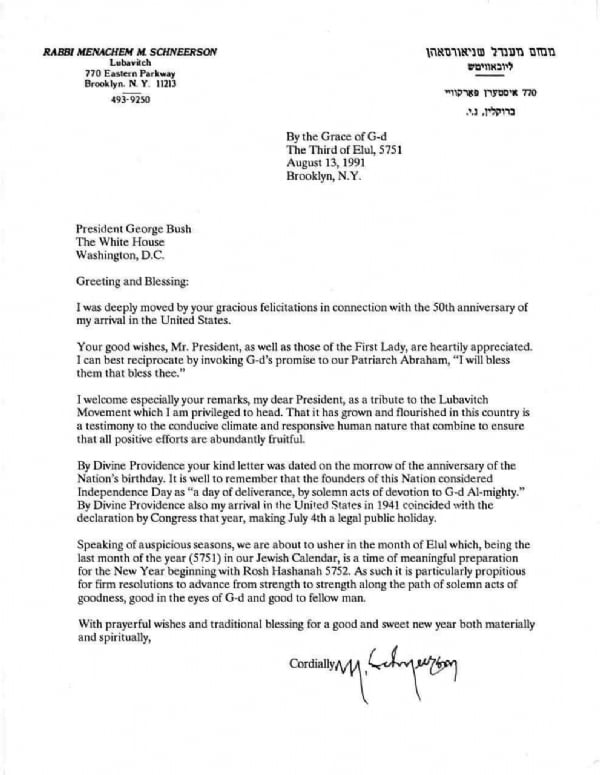
It was on this this day in 1941 that the Rebbe and the Rebbetzin safely arrived in America, having fled war-torn Europe on one of the the last passenger ships to cross the Atlantic before travel became impossible due to a German u-boat blockade. Thus, today is known as the "yom hatzalah," the day of rescue, for the Rebbe and the Rebbetzin.  The Rebbe was tremendously grateful for the gift that is America, and would commonly refer to this country as "Medina Shel Chesed", a country of kindness. (See below for a letter the Rebbe penned to President Bush (Sr.) on this theme)  


The Rebbe also emphasized that the significance of his move to America was not merely about what he was fleeing from but equally, if not more so, about what he was moving toward. Sadly, at that time, some Jews had abandoned Jewish practices seeing freedoms of America, and modernity in general, as contradictions to a Torah lifestyle.


The Rebbe saw no such contradiction.  He saw these freedoms as something, when when harnessed properly, could maximize our Jewish lives! Together with the challenges of modernity also come tremendous opportunities. A Judaism with more pride and joy. A fresh relevance to Torah. The ability to positively influence the wider world.  


When a Jew decides to adopt a life of Judaism today it is that much more meaningful, truly coming from our freedom of choice. As the Rebbe once told writer Herman Wouk regarding American Jews, “While you cannot tell them to do anything, you can teach them to do everything.  


Please G-d, America should remain that Medina Shel Chesed.  In the words of the prayer for the country we recite each Shabbos, "that the leaders and all their counselors and aides be inspired to deal kindly with us and with all Israel."


Looking for older posts? See the sidebar for the Archive.